YINSH
A game of change
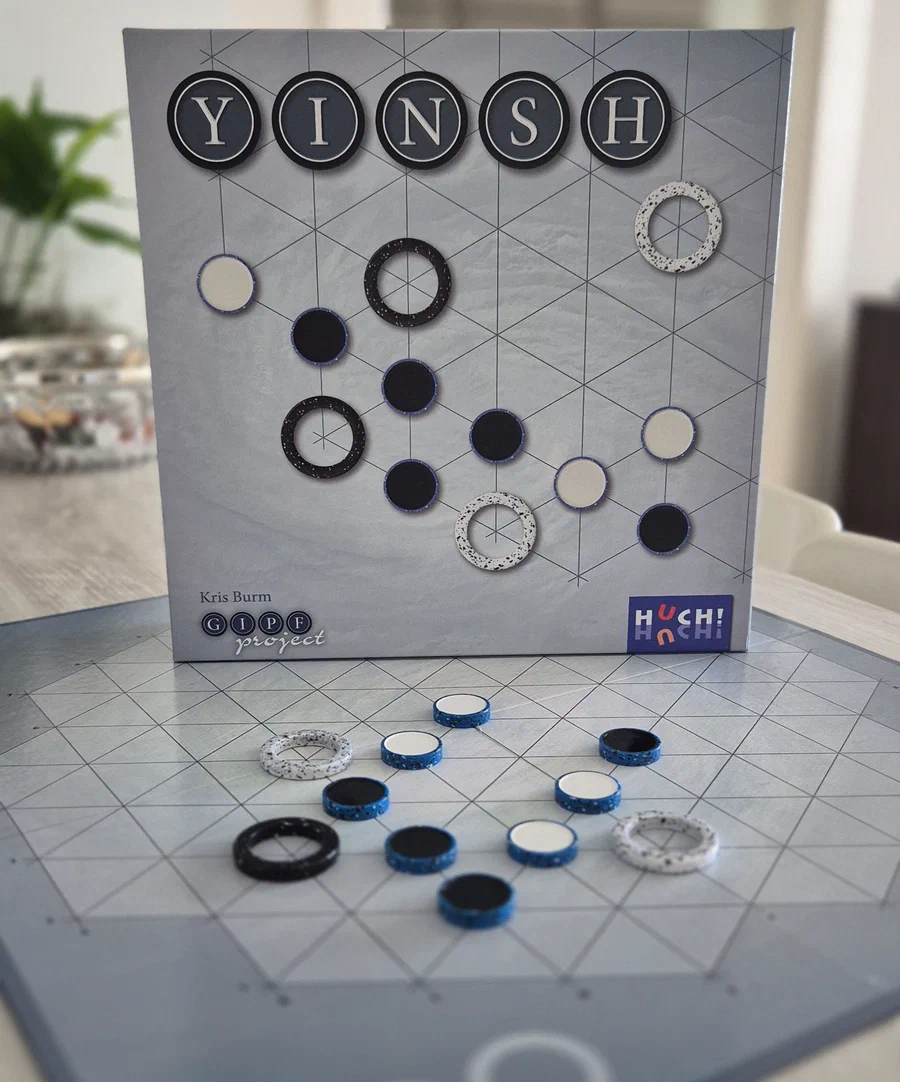
YINSH (YINSH) is game number 6 (we won’t dig into the numbering quirks) in the Project GIPF series by the great maestro of abstract board games — Kris Burm. It was released in 2003 and currently holds a solid 4th place in the BGG abstract ranking, making it the most popular game in Project GIPF.
As in every other Project GIPF game, the designer leans hard on the hexagon: the board is a concave hexagon (with the vertices cut off). Each player starts with five rings, placed in turn on any intersection of lines (including the edges). The goal is to remove 3 of your own rings from play (there is also a blitz version — until the first ring removed).
Once all rings are on the board, the tabia ends and movement begins. Every turn has three strictly ordered steps:
- Placement: the player takes a marker from the reserve and puts it, own colour up, inside any of their rings.
- Movement: the player must slide that ring in a straight line to any other empty point. The marker just placed stays where the ring was. You may not jump over rings (yours or the opponent’s). You may not end the move on a point that already holds a marker or a ring. If the ring “jumps” over markers, it must land on the next empty point immediately after the last marker jumped.
- Flipping (a Reversi-style effect):
- If the ring moves only over empty points, nothing happens.
- If the ring jumps over a run of markers (own or opponent), those markers flip to the opposite colour.
By moving rings and flipping markers, players try to form a row of 5 markers of their colour. Those 5 must be adjacent and in a straight line. Rings do not count.
When a player forms such a row, they must remove those 5 markers from the board and return them to the shared pool. Then they must also remove one of their rings (any ring) from the board.
In YINSH the designer built in a neat leader-weakening mechanic: every time you complete a row, you must remove one of your rings — cutting your mobility and the number of manoeuvres you can still make.
Full English rules are here.
Basic tactics
YINSH rules take five minutes to learn, but tactical depth takes months. Like the rest of Kris’s games, YINSH is a classic case of “easy to learn, hard to master.”
Here are a few fundamental tactics useful for beginners and strong players alike.
Building “forks” (double attacks)
Trying to build a five-in-a-row in plain sight is pointless. A competent opponent will see the threat at once and block it with a ring or flip your markers. The only reliable way to score is to create a “fork”: one move that threatens two potential five-marker lines in different directions. The opponent cannot stop both in one turn, so one of them will score for you.
How to do it: look for axis intersections. Build two crossing lines of 3–4 markers that share a key point.
Center versus edge
In the placement phase beginners often rush the center. There is more room to manoeuvre and more directions to attack. The downside is huge — you are open to hits from every side.
Edge play: strong players often use the edge as a shield. A ring pressed to the edge is harder to jump over, and its markers are harder to invert. Use the side lines to grow your chains quietly, where they are harder to attack.
Center control: the center is better for manoeuvring than for building rows. Keep 1–2 rings there as a “mobile strike force”, ready to leap across the board and wreck the opponent’s plans.
Using opponent markers
Remember that a ring flips every marker it jumps over. Opponent markers are your building material.
Do not panic if the opponent has a line of 3 or 4 markers. If your ring’s path can jump that run, one move turns their potential score into your own setup.
Defensive tip: never leave long marker chains “naked”. Keep one of your rings nearby to block the jump line for the opponent.
Crisis management
YINSH’s central paradox (losing a ring when you complete a row) forces a unique endgame approach.
- The first-point trap: scoring the first row too early hands over the initiative. An opponent with 5 rings will squeeze your 4, take board control, and catch up fast.
- Stockpiling: it is often better not to clear a completed row at once (when the rules or the position let you delay) and instead prepare a foothold for a second row. The ideal is removing your first ring while you already have a structure that lets you take the second on the next move.
Verdict
Among abstract-strategy fans, YINSH has earned the unofficial title “game of change.” Honestly, though, YINSH is a game of chaos. In many games the board evolves: pieces leave one by one, space opens up, and the position grows more predictable. YINSH runs on the opposite laws. The board is a boiling pot. A single ring jump over a long run of markers can flip the situation 180 degrees, turning one player’s dominance into the other’s triumph. Trying to calculate 15 moves ahead is doomed: the chaos of local inversions runs too deep.
And one last reminder: only the third row matters!