Top Cap
Simple is not a flaw
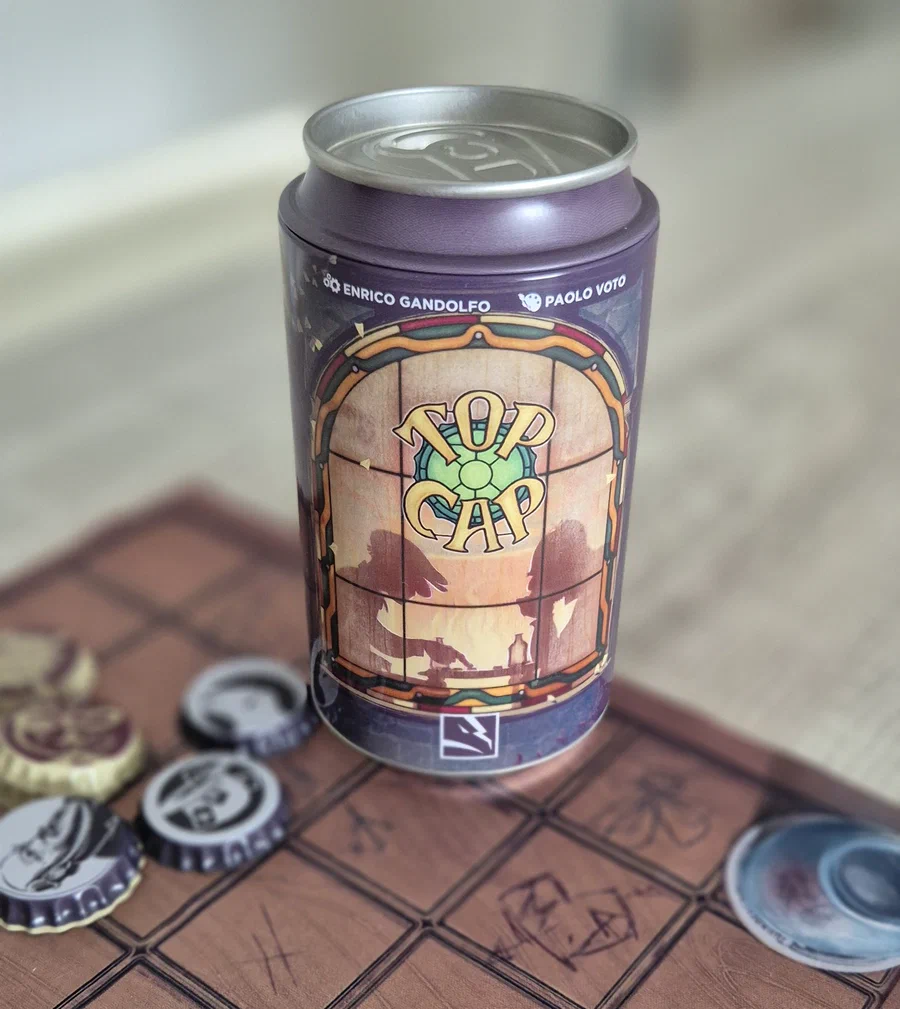
I hesitated a long time before writing about this game — next to heavyweights like TZAAR or DVONN it looks almost too simple. Honestly, even the brisk tactics of Cat-a-comb can feel extremely complex beside it. Yet Top Cap fits this blog’s theme perfectly: a pure deterministic abstract with perfect information. Extreme simplicity here is not a weakness — it is the main virtue.
So, Top Cap is one of the fast pocket games in the Soda Pop line by Enrico Gandolfo, published by ThunderGryph Games in 2024.
The tin is minimal: a cloth 6×6 board and four bottle caps per player (beer or lemonade — take your pick). You can improvise the same game in any bar: draw the board on a napkin, ask the bartender for caps.
The goal is simple: get one of your caps onto the bottle square at the opposite end of the board before the opponent does the same. You may not land on your own bottle. You also lose if you have no legal move.
A draw is possible: when each side has only one legal move and they can repeat it forever.
Starting setup (base variant)
You cannot jump over caps (friendly or enemy); slipping diagonally between caps is fine. A cap always moves exactly as far as the number of other caps (any colour) on adjacent squares.
A lonely piece cut off from the group has zero mobility and sits still.
Starting setup variant #1
Every turn you try to improve your caps’ mobility and hurt the opponent’s.
Moreover, maintaining mobility is not always about lengthening your moves: on a cramped board, too much range can become a trap when distances exceed the board.
Starting setup variant #2
Top Cap is a classic filler: perfect as a warm-up before something heavier. Another upside of that simplicity — it is a great gateway for people new to deterministic games, and the low barrier does not scare them off.
Starting setup variant #3
If I were the publisher, I’d put the artwork on the back of the covers so they could be laid out face down — this would make it easier to move them across the cloth margin with a finger or to pick them up more quickly, without having to pick at the cover with a fingernail, which would risk creasing or displacing the thin cloth margin each time.
Tactical tips:
The main diagonal
Often occupying the main diagonal between the bottles is strong. It keeps the opponent under pressure: they must either block that diagonal or keep enough neighbouring caps around yours that you cannot jump onto the bottle.
Mobility
Mobility wins games. Arrange your caps to keep move lengths around 1–3 squares. If a piece is squeezed by four or more neighbours, it risks getting stuck.
Multiple attack vectors
Never put everything on one cap. Spread your caps so you threaten from several directions and with different neighbour counts.