GIPF
A game of potentials
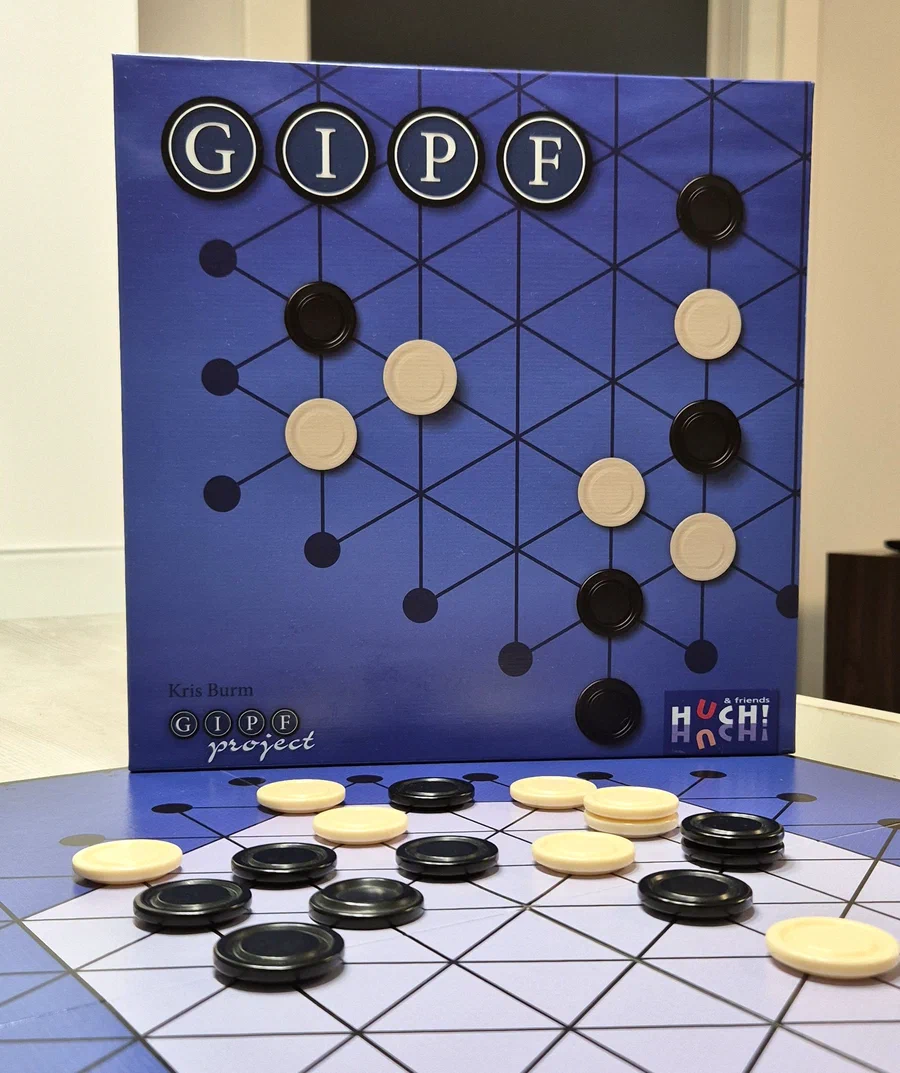
GIPF (GIPF) is a landmark among deterministic, perfect-information abstracts. Belgian designer Kris Burm created it in far away 1996.
GIPF opened the Project GIPF that now includes nine games (one has since left the project and is no longer reprinted). We have already written about some of them, including TZAAR and DVONN.
Standard rules
As in the other games of the project, the GIPF board is a hexagon. Here it is equilateral with side length 5, with nodes joined by lines along which pieces move. The 24 outer nodes are not playable — they are only used to bring new pieces into play. Each player has 18 pieces of their colour. On your turn you must introduce a new piece: place it on any outer node and move it exactly one cell along a line from that node, either onto an empty playable cell or by pushing the piece already there (and every piece in the contiguous line after it) one cell further in the same direction.
As soon as four pieces of one colour form a contiguous row, that player must take them off the board. They take not only those four, but every piece that extends the row in both directions. Own-colour pieces return to the player’s reserve; opponent pieces are captured and leave the game.
Besides basic pieces there are GIPF pieces — two basic pieces stacked. On the board a GIPF piece counts as one piece, but it returns to the reserve as two basic pieces. The difference is that GIPF pieces need not be removed. When a GIPF piece (of either colour) is part of a row that must leave the board, the player may take it or leave it in place.
A player loses if they cannot bring a new piece onto the board (the reserve is empty) or if none of their GIPF pieces remain on the board.
Players start with three GIPF pieces already on the playable corner cells of the hexagon, alternating black and white.
Tournament rules
Tournament play adds an opening phase — the tabia. The board starts empty, and players take turns introducing GIPF pieces by the usual push rules. Each player chooses where, and how many, GIPF pieces to bring in. As soon as a player introduces their first basic piece, their tabia ends. From then on they may only introduce basic pieces (the opponent’s tabia continues until they make the same choice).
Full rules (PDF) are here.
A game of potentials
GIPF is called a game of potentials, though the name is not obvious at first. The game can be expanded with extra pieces that Kris Burm called potentials. A potential is an element added to a basic GIPF piece. A piece “loaded” with a potential can make a move a basic piece cannot. Each game in the project adds its own potential, giving a piece abilities typical of that game:
ZERTZ potential — jump over one piece or a chain of pieces onto an empty cell.
DVONN potential — jump onto an enemy piece to form your own tower.
YINSH potential — slide in a straight line through empty cells.
TZAAR/TAMSK potential — split a stack and take an extra move at once.
PÜNCT potential — a direct attack that demotes an opponent’s GIPF piece.
Actually, the GIPF piece from the base game is itself the GIPF potential: it protects a piece from being removed when a row is formed.
Adding potentials to basic GIPF makes an already highly variable game even richer.
Summary
GIPF is not only the foundation of the famous series — it may also be one of its deepest games. Games last somewhat longer than in ZERTZ, DVONN, or TZAAR. Unlike those titles, where the playable area shrinks as the game goes on, the GIPF board keeps its full size until the end.