DVONN
A game of mobility
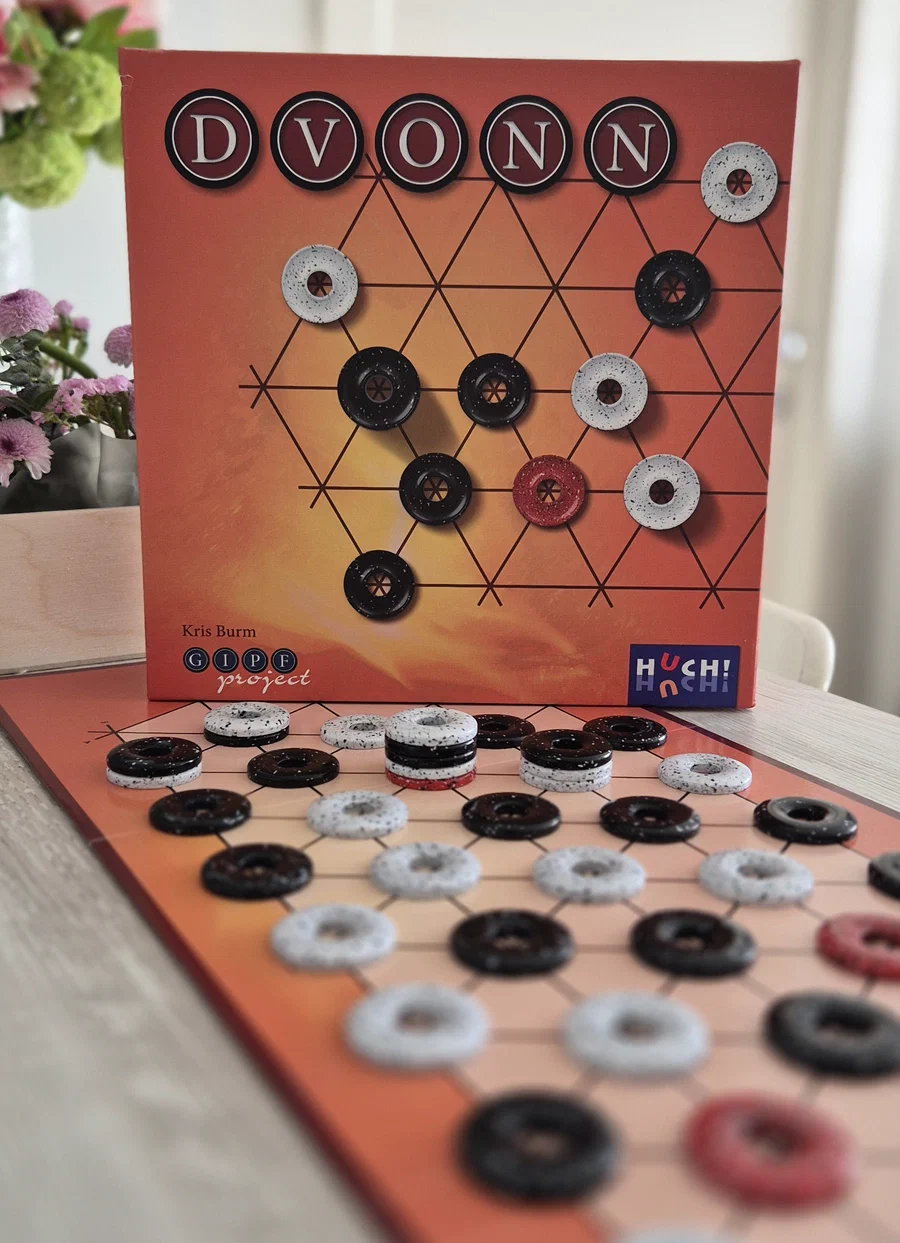
DVONN (DVONN) is the fourth game of Project GIPF by Belgian designer Kris Burm, first released in 2001. It currently sits firmly at 12th among abstract games on BoardGameGeek.com, behind two Project siblings — TZAAR and YINSH.
As in all Project GIPF games, the board is a hexagon — not equilateral here, but elongated: short sides of length 3, long sides of length 9.
There are 23 white and 23 black pieces (one set per player) plus 3 neutral red DVONN pieces. Players try to control as many pieces as possible by stacking them, and to keep their stacks connected (directly or through a chain of stacks) to the DVONN pieces. The colour on top of a stack decides who controls it. The game ends when neither player can move. The winner is whoever has the most pieces in stacks they control (regardless of colours inside the stacks).
Full rules (PDF) are here.
Play starts on an empty board and has two phases:
- Piece placement (tabia) — players alternately place pieces on any empty cell. Placement rules for DVONN pieces are in the full rules.
- Moving pieces and stacks — starting with the first player, each turn moves a controlled stack. A lone piece is a stack of height 1, so we call everything on the board a stack. You may only move stacks of your colour that are not surrounded on all six sides (by any colour). A stack always moves as a whole exactly as many spaces as it has pieces. DVONN pieces cannot be moved alone, but may be part of a stack and then move with it. Movement is in a straight line in any direction, but the stack must land on another stack (any colour).
Typical beginner mistakes:
The game starts with placement!
Splitting DVONN into phases trips up many beginners: the game does not start with the first piece move, but with the tabia — placing pieces on the board. That tabia is the strategic phase that lays the foundation for later tactics. Skip it and you often place pieces at random, then find yourself lost by the middlegame.
Controlling tall stacks in the opening
Tall stacks score well at the end but have low mobility, make juicy targets, and can be stolen at any time. Building a tall stack in the opening can mean gifting it to the opponent in the endgame.
Of course, seizing a tall stack early is sometimes right — for example if it stops the opponent controlling a DVONN piece that could later cut your stacks off.
Strategy and tactics tips:
Unlike many games, DVONN has few hard “named” strategies — think in terms of tactical habits instead.
Placement-phase tips (tabia)
Sample setup.
Arrange so you can reach that goal in several ways:
- direct control: place a piece that can land on a DVONN piece;
- secondary control: place a piece that, after one move, can take a DVONN piece;
- third-order control, and so on.
In the example, Black on e2 holds the DVONN on e3 under direct control and the one on c3 under secondary control, with a path via e1 to threaten c3 next.
Movement-phase tips
The ideal move
You can list conditions for an ideal move — the more it satisfies, the stronger it is. An ideal move:
- Covers an opponent stack, denying that attack and reducing their options.
- Frees one or more of your stacks from a ring of six neighbours.
- Does not free any opponent stacks.
- Reduces the value of one or more opponent stacks — e.g. they can no longer attack yours (same colour only) or move at all.
- Cuts opponent stacks from DVONN pieces, or increases the chance of doing so later.
- Forces the opponent to answer your threat instead of attacking themselves.
Counting moves
Zugzwang. Critical position.
The diagram shows Black in zugzwang: they must move, and the only move is with c2, which cuts their stack on c1 from the DVONN on c3. If it is White’s turn, they are in the same bind — the forced e2 > c2 cuts e1 from e3.
Realising control
If you potentially control an area with several ways to take DVONN pieces or valuable stacks, you need not always cash in that control. When both sides have equal control options, the first to move into the area often loses the advantage and leaves the opponent the last word. Watch for distant threats from the other side of the board that can flip control of that region.