Analogue calculation
Online vs Offline
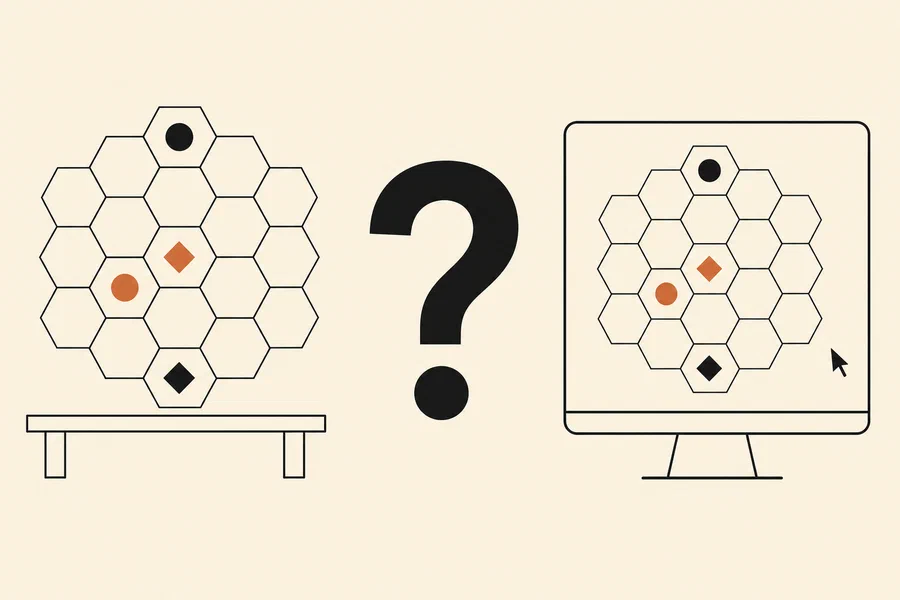
The trap of digital convenience
COVID lockdowns and travel limits showed how useful online services are. They let board gamers keep playing despite hard physical limits. A phone in the pocket or a desktop can start a game in seconds. Algorithms match an opponent across the planet; the UI highlights legal moves and watches the clock. Online play gave us absolute, unprecedented convenience.
But that convenience has a hidden cost.
Moving a complex abstract strategy onto a flat screen quietly simplifies how we think. A mouse and a touchscreen flatten every action: buying something in a web shop, scrolling a feed, and a decisive move in a hard game all ask the same automatic finger motion. Deep calculation turns into a chain of light, almost reflexive clicks.
When a game loses its physical shell, the brain loses an important cognitive support. That is why, to unlock the real depth of deterministic games, we still need the analogue format — tangible piece weight, the feel of the board, and live emotional feedback from the person across the table.
Psychology and “reading” the opponent
In perfect-information games you need not guess which cards they hold. You do need to understand their emotional state.
- Online: The opponent is a faceless nickname and a dry digital move. You do not know if they are confident or panicking.
- Offline: That opponent modelling (Theory of Mind) we wrote about kicks in. You see micro-expressions, body language, how they hold a piece, breathing, eye movement. Live play becomes a psychological duel where you can bluff with a confident face even from a weak position.
Sense of time and “kinaesthetic” focus
- Online: It is too easy to move on autopilot, following impulse. Digital noise (notifications, browser tabs) constantly pulls attention away.
- Offline: Touching wooden chess pieces, TZAAR discs, or Cat-a-comb cubes engages sensory cortex. Tactile contact grounds you, returns you to “here and now,” and pushes the cognitive system to work deeper. Offline play is an ideal digital detox.
Social ritual and the culture of dispute
Face-to-face play is a respectful intellectual dialogue. A live opponent invites more empathy. Offline, toxic rage-quits (closing the app mid-game) and insults are almost absent.
After a live game comes the most valuable stage — a shared review of mistakes (analysis), when you can ask: “What were you thinking on that move?” Online, that experience is almost always lost.
Tactility and component aesthetics
Most abstracts have restrained, classical looks without loud colours or flashy card art. That is usually offset by the quality of the physical pieces. It feels good to hold a hand-carved chessman, feel the weight of a Zèrtz ball, hear the satisfying click of a capture in DVONN or TZAAR. Moving pieces itself becomes intellectual and sensory pleasure.
Online, every element moves with the same weightless pixel animation. Clicking a plastic mouse button or tapping a screen does not give that clear feedback. The brain treats the game as another digital task. Online clients try to fake the feel with animation and sound — but it remains imitation.
Offline, weight, material, and temperature of components create deep sensory involvement. Sliding a heavy, well-made piece across a smooth board gives aesthetic satisfaction that underlines the seriousness of the decision you just made. Placing a piece properly becomes an act of deliberate intent, so strategic calculation feels “grounded” and real.
Cheating and digital assistants
In deterministic games the result depends 100% on calculation quality. That makes them vulnerable to the main plague of the digital age — engines and AI hints (cheating). Some abstracts are mathematically shallow enough (offset by other aspects that keep them interesting for humans) that algorithms can always outplay any person.
- Online: You can never be fully sure whom you face. Your opponent across the planet may run a chess engine or an AI helper in the next tab. That breeds quiet distrust, paranoia, and cheapens the joy of winning.
- Offline: Cheating in open-information games is almost impossible. The phone is in a pocket; every action happens in front of the opponent. You know you face a living mind — its weaknesses, limits, and talent. That builds an honest, safe intellectual space.
Even pure abstract calculation needs reality
Online platforms are invaluable for quick practice and finding opponents any hour of the day. But they give only a digitised copy of the experience.
Real analogue calculation is not just shuffling tokens on a grid. It is a full process: physical piece weight, deep focus without digital noise, reading a live person’s emotions, and absolute trust in a clean game. To feel the true philosophy and depth of abstract strategy, close the laptop now and then, put the phone aside, and sit down at a real wooden or stone table.