Dieter Stein’s Stacking Trilogy
Revealing game series
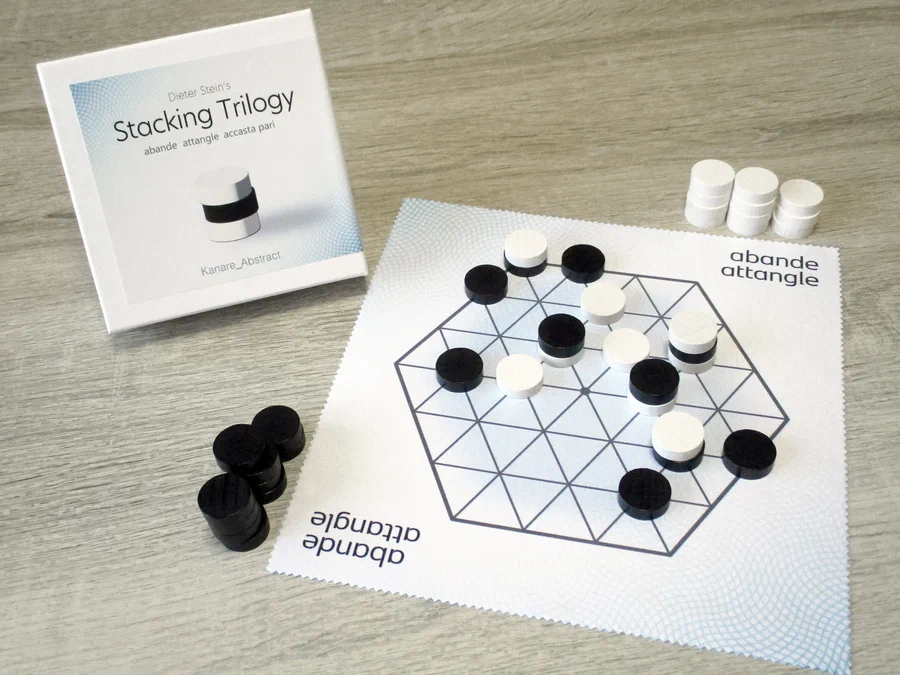
In today’s world, it is easy to get lost in the sheer abundance of board games, and the genre of abstract deterministic strategies remains niche, often suffering from a lack of publisher interest. Rare exceptions — such as Kris Burm and his Project GIPF, which achieved both relative commercial success and high positions in the BGG abstract game rankings only prove this rule. Because of this, true hidden gems often fail to reach players. Here at Disput, we search for these gems, polish them, and present them to the public.
Accasta Pari
They were released in a single box titled “Stacking Trilogy” and are united by a shared core game mechanics: stacking. Another common feature — with one minor exception — is a hexagonal board.
These games reflect different milestones in the evolution of Dieter’s design philosophy, starting from his debut Accasta (1998) and moving to the more modern Abande (2005) and Attangle (2006). Together, they vividly demonstrate how the very same mechanics can be used in ways so fundamentally different that it completely transforms the feel and perception of a game. In this regard, the games of the “Stacking Trilogy” echo the works of master Kris Burm, who likewise makes virtuosic use of both stacking and hexagonal boards.
Three facets of a single mechanics
- Accasta (1998)
The stack as a mobile squad. In his very first game, Stein bet on dynamism. A stack here never stays in one place: it can be split on the move, dropping pieces along its path to execute long tactical combinations.
- Abande (2005)
The stack as score and a connective link. Seven years later, the author completely flipped the concept. In Abande, stacks lose a significant portion of their mobility, tending instead to grow in place (up to a maximum of three tiers). The cardinal rule of the game is that all pieces and stacks on the board must form a single connected group (band) at all times. Here, the stack acts as a load-bearing pillar for the entire structure and doubles as a score counter.
- Attangle (2006)
The stack as part of a geometric fork. The final chapter of the trilogy shifts the focus to positional encirclement. Unlike its predecessors, you cannot simply jump onto an adjacent enemy stack alone — capturing requires support from two different directions. Stacks cease to be autonomous fighters and instead operate in tandem, steering the gameplay toward a geometric puzzle.
What’s next
The “Stacking Trilogy” is a textbook example of how a basic set of components can give rise to three completely distinct gaming experiences: dynamic tactics in Accasta, a viscous struggle for connectivity — and an almost Western-style standoff waiting to see who loses their nerve first — in Abande, and subtle positional calculation in Attangle. In upcoming entries of this series, we will try to take an in-depth look at each game in the “Stacking Trilogy” box, exploring the nuances of their rules, fundamental strategic principles, and key tactical motifs.
P.S.
And now for the classic question from anyone whose interest has been piqued: where can you actually play these games? We have an answer for that — in fact, three of them!
At the time of writing, boxes of the “Stacking Trilogy” are available to order on the Kanare_Abstract website.
Accasta with TZAAR pieces on GIPF board
If for any reason you cannot order from the publisher but still want to play a physical copy, there is a handy lifehack for fortunate owners of Kris Burm’s games: a GIPF board works brilliantly as the playing surface. For Abande and Attangle, you can also use GIPF pieces — the piece count matches completely. Accasta is slightly trickier, as it requires two extra pieces of each color, though you can use pieces from TZAAR or DVONN instead, which provides more than enough. Moreover, jumping ahead, TZAAR pieces allow you to play both variants of Accasta — Standard and Pari (incidentally, the pieces included in the “Stacking Trilogy” box only allow you to play the Accasta Pari variant).
As a nice bonus, unlike the pieces from Kanare_Abstract, pieces from Project GIPF games are much better suited for building stacks.
For those who cannot use either of the options above, you can play online. Abande (the hexagonal board variant only) and Attangle are available to play on Dieter’s own website, Spielstein. He actively maintains his brainchild, and we think he would be delighted if you visited his site and played a few games there.
Additionally, Abande (with all board variants) and Accasta (also in all variants) are available to play on Abstract Play.
Image credits: Kanare_Abstract.